
Regulations Limiting Carbon Dioxide Emissions from Natural Gas-fired Generation of Electricity (SOR/2018-261)
Full Document:
- HTMLFull Document: Regulations Limiting Carbon Dioxide Emissions from Natural Gas-fired Generation of Electricity (Accessibility Buttons available) |
- XMLFull Document: Regulations Limiting Carbon Dioxide Emissions from Natural Gas-fired Generation of Electricity [155 KB] |
- PDFFull Document: Regulations Limiting Carbon Dioxide Emissions from Natural Gas-fired Generation of Electricity [499 KB]
Regulations are current to 2026-06-21 and last amended on 2019-01-01. Previous Versions
Marginal note:Quantity of energy
11 (1) The quantity of energy produced by a given unit is determined by the formula
G + (0.75 × Hpnet)
where
- G
- is
(a) the gross quantity of electricity generated by the unit in the calendar year expressed in GWh, as measured at the electrical terminals of the generators of the unit using meters that comply with the requirements of the Electricity and Gas Inspection Act and the Electricity and Gas Inspection Regulations, or
(b) in the case of a hybrid configuration – when the unit is either a combustion engine unit that shares a steam turbine with a boiler unit or a boiler unit that shares a steam turbine with a combustion engine unit – the quantity of electricity generated by the given unit in the calendar year expressed in GWh, determined by the formula in subsection (2); and
- Hpnet
- is the net quantity of useful thermal energy produced by the unit in a calendar year, expressed in GWh, determined by the formula in subsection (3).
Marginal note:Quantity of electricity — hybrid configuration
(2) The quantity of electricity generated by a given unit is determined by the formula
Gce + Gs – Gext
where
- Gce
- is the gross quantity of electricity that is generated by the generators of the combustion engines in a combustion engine unit that shares a steam turbine with a boiler unit, in the calendar year, expressed in GWh, as measured at the electrical terminals of the generators of the combustion engines using meters that comply with the requirements of the Electricity and Gas Inspection Act and the Electricity and Gas Inspection Regulations, if the given unit for which the electricity is being quantified is a combustion engine unit, or equal to zero, if the given unit for which the electricity is being quantified is a boiler unit;
- Gs
- is the gross quantity of electricity that is generated by the generators of the shared steam turbine in the calendar year, expressed in GWh, as measured at the electrical terminals of the generators of the shared steam turbine using meters that comply with the requirements of the Electricity and Gas Inspection Act and the Electricity and Gas Inspection Regulations; and
- Gext
- is the quantity of electricity that is generated by the unit other than the given unit for which the electricity is being quantified, in the calendar year, expressed in GWh and that is determined by the formula
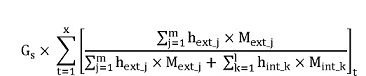
where
- Gs
- is the gross quantity of electricity that is generated by the generators of the shared steam turbine in the calendar year, expressed in GWh, as measured at the electrical terminals of the generators of the shared steam turbine using meters that comply with the requirements of the Electricity and Gas Inspection Act and the Electricity and Gas Inspection Regulations,
- t
- is the tth hour, where “t” goes from the number 1 to x and where x is the total number of hours during which the generators of the shared steam turbine generated electricity in the calendar year,
- j
- is the jth external heat stream, originating from the other unit where “j” goes from the number 1 to m and where m is the total number of external heat streams that contributed to the electricity generated by the generators of the shared steam turbine of the unit,
- hext_j
- is the average specific enthalpy of the jth external heat stream, originating from the other unit that contributed to the electricity generated by the generators of the shared steam turbine, expressed in GJ/tonne, during period “t” and must be based on the measurement of the temperature and pressure of that heat stream and determined using a continuous measuring device,
- Mext_j
- is the mass flow of the jth external heat stream originating from the other unit that contributed to the electricity generated by the generators of the shared steam turbine, expressed in tonnes, during period “t”, determined using a continuous measuring device,
- k
- is the kth internal heat stream originating from the given unit, where “k” goes from the number 1 to l and where l is the total number of heat streams that originated from the combustion of fuel in the unit and that contributed to the electricity generated by the generators of the shared steam turbine,
- hint_k
- is the average specific enthalpy of the kth internal heat stream originating from the given unit and having contributed to the electricity generated by the generators of the shared steam turbine, expressed in GJ/tonne, during period “t” and must be based on the measurement of the temperature and pressure of that heat stream and determined using a continuous measuring device, and
- Mint_k
- is the mass flow of the kth internal heat stream originating from the given unit that contributed to the electricity generated by the generators of the shared steam turbine, expressed in tonnes, during period “t”, determined using a continuous measuring device.
Marginal note:Net quantity of useful thermal energy
(3) In the case of a unit that simultaneously generates electricity and produces useful thermal energy from the fuel combusted by a combustion engine or boiler, as the case may be, the net quantity of useful thermal energy produced by the unit in a calendar year, expressed in GWh, is determined by the formula

where
- t
- is the tth hour, where “t” goes from the number 1 to x and where x is the total number of hours during which the unit produced useful thermal energy in the calendar year;
- i
- is the ith heat stream exiting the unit, where “i” goes from the number 1 to n and where n is the total number of heat streams exiting the unit;
- hout_i
- is the average specific enthalpy of the ith heat stream exiting the unit, expressed in GJ/tonne, during period “t” and must be based on the measurement of the temperature and pressure of that heat stream and determined using a continuous measuring device;
- Mout_i
- is the mass flow of the ith heat stream exiting the unit, expressed in tonnes, during period “t”, determined using a continuous measuring device;
- j
- is the jth heat stream — other than condensate return — entering the unit, where “j” goes from the number 1 to m and where m is the total number of heat streams entering the unit;
- hin_j
- is the average specific enthalpy of the jth heat stream — other than condensate return — entering the unit, expressed in GJ/tonne, during period “t” and must be based on the measurement of the temperature and pressure of that heat stream and determined using a continuous measuring device; and
- Min_j
- is the mass flow of the jth heat stream — other than condensate return — entering the unit, expressed in tonnes, during period “t”, determined using a continuous measuring device.
Page Details
- Date modified: