
Regulations Limiting Carbon Dioxide Emissions from Natural Gas-fired Generation of Electricity (SOR/2018-261)
Full Document:
- HTMLFull Document: Regulations Limiting Carbon Dioxide Emissions from Natural Gas-fired Generation of Electricity (Accessibility Buttons available) |
- XMLFull Document: Regulations Limiting Carbon Dioxide Emissions from Natural Gas-fired Generation of Electricity [155 KB] |
- PDFFull Document: Regulations Limiting Carbon Dioxide Emissions from Natural Gas-fired Generation of Electricity [499 KB]
Regulations are current to 2026-06-21 and last amended on 2019-01-01. Previous Versions
Marginal note:Measured carbon content
18 (1) The quantity of CO2 emissions, that is attributable to the combustion of a fossil fuel in a unit in a calendar year is determined by one of the following formulas, whichever applies:
(a) for a gaseous fuel,
Vf × CCA × (MMA/MVcf) × 3.664 × 0.001
where
- Vf
- is the volume of the fuel combusted in the calendar year, determined using flow meters, expressed in standard m3,
- CCA
- is the weighted average of the carbon content of the fuel, determined in accordance with subsection (2), expressed in kg of carbon per kg of the fuel,
- MMA
- is the average molecular mass of the fuel, determined based on fuel samples taken in accordance with section 19, expressed in kg per kg-mole of the fuel, and
- MVcf
- is the molar volume conversion factor of 23.645 standard m3 per kg-mole of the fuel at standard conditions;
(b) for a liquid fuel,
Vf × CCA × 3.664
where
- Vf
- is the volume of the fuel combusted in the calendar year, determined using flow meters, expressed in kL , and
- CCA
- is the weighted average of the carbon content of the fuel, determined in accordance with subsection (2), at the same temperature as that used in the determination of Vf, expressed in tonnes of carbon per kL of the fuel; and
(c) for a solid fuel,
Mf × CCA × 3.664
where
- Mf
- is the mass of the fuel combusted in the calendar year, determined, as the case may be, on a wet or dry basis using a measuring device, expressed in tonnes, and
- CCA
- is the weighted average of the carbon content of the fuel, determined in accordance with subsection (2), on the same wet or dry basis as that used in the determination of Mf, expressed in kg of carbon per kg of the fuel.
Marginal note:Weighted average
(2) The weighted average “CCA” referred to in paragraphs (1)(a) to (c) is determined by the formula
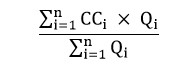
where
- CCi
- is the carbon content of each sample or composite sample, as the case may be, of the fuel for the ith sampling period, expressed for gaseous fuels, liquid fuels and solid fuels, respectively, in the same unit of measure as that set out in CCA, as provided by the supplier of the fuel to the responsible person or, if not so provided, as determined by the responsible person in the following manner:
(a) for a gaseous fuel,
(i) in accordance with whichever of the following standards for the measurement of the carbon content of the fuel that applies:
(A) ASTM D1945-14, entitled Standard Test Method for Analysis of Natural Gas by Gas Chromatography,
(B) ASTM UOP539-12, entitled Refinery Gas Analysis by Gas Chromatography,
(C) ASTM D7833-14, entitled Standard Test Method for Determination of Hydrocarbons and Non-Hydrocarbon Gases in Gaseous Mixtures by Gas Chromatography, and
(D) API Technical Report 2572, 1st edition, published in May 2013 and entitled Carbon Content, Sampling, and Calculation, or
(ii) by means of a direct measuring device that measures the carbon content of the fuel,
(b) for a liquid fuel, in accordance with whichever of the following standards or methods for the measurement of the carbon content of the fuel that applies:
(i) API Technical Report 2572, 1st edition, published in May 2013 and entitled Carbon Content, Sampling, and Calculation,
(ii) ASTM D5291-16, entitled Standard Test Methods for Instrumental Determination of Carbon, Hydrogen, and Nitrogen in Petroleum Products and Lubricants,
(iii) the ASTM standard that applies to the type of fuel, or
(iv) if no ASTM standard applies, an applicable internationally recognized method, and
(c) for a solid fuel, on the same wet or dry basis as that used in the determination of CCA, in accordance with,
(i) for a solid fuel derived from waste, ASTM E777-08, entitled Standard Test Method for Carbon and Hydrogen in the Analysis Sample of Refuse-Derived Fuel, and
(ii) for any other solid fuel, the following standard or method for the measurement of the carbon content of the fuel:
(A) the ASTM standard that applies to the type of fuel, and
(B) if no ASTM standard applies, an applicable internationally recognized method;
- i
- is the ith sampling period that is referred to in section 19, where “i” goes from the number 1 to n and where n is the number of those sampling periods; and
- Qi
- is the volume or mass, as the case may be, of the fuel combusted during the ith sampling period, expressed
(a) in standard m3, for a gaseous fuel,
(b) in kL, for a liquid fuel, and
(c) in tonnes, for a solid fuel, on the same wet or dry basis as that used in the determination of CCA.
Page Details
- Date modified: