
Fishery (General) Regulations (SOR/93-53)
Full Document:
- HTMLFull Document: Fishery (General) Regulations (Accessibility Buttons available) |
- XMLFull Document: Fishery (General) Regulations [224 KB] |
- PDFFull Document: Fishery (General) Regulations [727 KB]
Regulations are current to 2026-09-21 and last amended on 2026-06-22. Previous Versions
Table of Contents
Fishery (General) Regulations
SOR/93-53
Registration 1993-02-04
Regulations Respecting Fishing and Fish Habitat in General and the Payment of Penalty and Forfeiture Proceeds Under the Fisheries Act
P.C. 1993-186 1993-02-04
His Excellency the Governor General in Council, on the recommendation of the Minister of Fisheries and Oceans, pursuant to sections 8, 43Footnote * and 79.7Footnote ** and subsection 87(2) of the Fisheries Act, is pleased hereby to revoke the Fishways Obstructions Removal Regulations, C.R.C., c. 814, and the Penalties and Forfeitures Proceeds Regulations, C.R.C., c. 827, and to make the annexed Regulations respecting fishing and fish habitat in general and the payment of penalty and forfeiture proceeds under the Fisheries Act, in substitution therefor, effective February 24, 1993.
Return to footnote *S.C. 1991, c. 1, s. 12
Return to footnote **S.C. 1991, c. 1, s. 24
Short Title
1 These Regulations may be cited as the Fishery (General) Regulations.
Interpretation
2 In these Regulations,
- Act
Act means the Fisheries Act; (Loi)
- band
band[Repealed, SOR/93-333, s. 1]
- Convention Area
Convention Area has the same meaning as in subsection 2(1) of the Atlantic Fishery Regulations, 1985; (zone de la Convention)
- Department
Department means the Department of Fisheries and Oceans; (ministère)
- document
document means a licence, fisher’s registration card or vessel registration card that grants a legal privilege to engage in fishing or any other activity related to fishing and fisheries; (document)
- fisher’s registration card
fisher’s registration card means a fisher’s registration card issued under any of the Regulations listed in subsection 3(4); (carte d’enregistrement de pêcheur)
- fish landing station
fish landing station means any place, premises, vessel or vehicle used to receive fish landed, whether directly or indirectly, from a fishing vessel; (poste de débarquement du poisson)
- licence
licence means any type, kind or category of licence issued under any of the Regulations listed in subsection 3(4) or under these Regulations; (permis)
- licence number
licence number means the number assigned to a licence by the Department at the time the licence is issued; (numéro de permis)
- observer
observer means a person who is designated under section 39 or 39.1; (observateur)
- provincial or territorial fisher’s certificate
provincial or territorial fisher’s certificate means a certificate of accreditation or registration, however described and regardless of format, that is issued to a commercial fisher through a program of accreditation or registration established under provincial or territorial legislation; (certificat provincial ou territorial de pêcheur)
- Regional Director-General
Regional Director-General means a Regional Director-General or an Associate Regional Director-General of the Department; (directeur général régional)
- registered vessel
registered vessel means a fishing vessel registered with the Department under any of the Regulations listed in subsection 3(4); (bateau enregistré)
- Regulatory Area
Regulatory Area means that part of the Convention Area that lies beyond the areas in which any country exercises fisheries jurisdiction; (zone de réglementation)
- vessel registration card
vessel registration card means a vessel registration card or vessel registration certificate issued under any of the Regulations listed in subsection 3(4); (carte d’enregistrement de bateau)
- vessel registration number
vessel registration number means the number assigned to a vessel by the Department at the time the vessel is registered as a fishing vessel under any of the Regulations listed in subsection 3(4). (numéro d’enregistrement de bateau)
- SOR/93-333, s. 1
- SOR/95-497, s. 1
- SOR/98-481, s. 1
- SOR/2020-255, s. 6
Application
3 (1) Subject to subsection (2), Parts I to VIII apply in respect of
(a) fishing and related activities in Canadian fisheries waters off the Atlantic, Pacific and Arctic coasts;
(b) fishing and related activities in the provinces of Nova Scotia, New Brunswick, British Columbia, Prince Edward Island and Newfoundland and Labrador and in the Yukon Territory and Northwest Territories; and
(c) fishing and related activities carried out in waters other than Canadian fisheries waters from vessels subject to the jurisdiction of Canada.
(2) Parts I to VIII do not apply in respect of fishing and related activities in respect of which the Quebec Fishery Regulations, 1990 apply.
(3) Parts IX and X apply in respect of Canada and Canadian fisheries waters.
(4) Where there is an inconsistency between these Regulations and any of the following Regulations, the following Regulations shall prevail:
(a) the Atlantic Fishery Regulations, 1985;
(c) the Foreign Vessel Fishing Regulations;
(d) the Marine Mammal Regulations;
(i) the Pacific Fishery Regulations, 1993;
(j) the Yukon Territory Fishery Regulations;
(l) the Pacific Aquaculture Regulations;
(m) the Aquatic Invasive Species Regulations; and
(5) Sections 18 to 21, 23 and 26 to 29 do not apply with respect to fishing and related activities carried out under the authority of a licence issued under the Aboriginal Communal Fishing Licences Regulations.
(6) Sections 18 to 21, 23, 26 and 29 do not apply in respect of Inuit domestic fishing, being the exercise by a person of the right to harvest any species or stock of fish for food, social and ceremonial purposes in accordance with the Agreement defined in section 2 of the Labrador Inuit Land Claims Agreement Act.
- SOR/93-333, s. 2
- SOR/94-296, s. 1
- SOR/2002-225, s. 8
- SOR/2003-369, ss. 1, 4
- SOR/2010-270, s. 8
- SOR/2015-121, s. 34
- SOR/2018-110, s. 6
- SOR/2024-237, s. 13
PART IPeriods of Time and Variation Orders
- SOR/2023-147, s. 2
Periods of Time
- SOR/2023-147, s. 2
4 Where a period of time is set out in any of the Regulations listed in subsection 3(4), the period
(a) unless otherwise specified, begins at 00:00 h on the first day set out and ends at 24:00 h on the last day set out; and
(b) begins and ends in each calendar year except that where the period is stated to end on a day in a month that occurs earlier in a calendar year than the month in which the period begins, that period begins in one calendar year and ends in the next calendar year.
5 (1) Subject to subsection (2), a reference to time in a provision of any of the Regulations listed in subsection 3(4) or a notice given under section 7 is a reference to local time in effect in the province or portion thereof that is closest to the waters in respect of which the provision or the notice applies unless, in the case of a notice, it is otherwise stated in the notice.
(2) Where notice is given under section 7 in respect of any close time set out in the Foreign Vessel Fishing Regulations, that time is a reference to Greenwich time.
Variation Orders
6 (1) If a close time, fishing quota, limit on the size or weight of fish or fishing gear or equipment is fixed in respect of an area under any of the Regulations listed in subsection 3(4), the Regional Director-General may, by order, vary that close time, quota, limit, gear or equipment in respect of that area or any portion of that area.
(2) If a close time, fishing quota or fishing gear or equipment for herring or salmon fishing is fixed in respect of an area under the Pacific Fishery Regulations, 1993, a fishery officer may, by order, vary that close time, quota, gear or equipment in respect of that area or any portion of that area.
(3) If a close time, fishing quota, limit on the size or weight of fish or fishing gear or equipment is fixed in respect of an area of non-tidal waters for any species of fish other than salmon under the British Columbia Sport Fishing Regulations, 1996, the director responsible for fisheries management in the ministry responsible for fisheries in the Government of British Columbia may, by order, vary that close time, quota, limit, gear or equipment in respect of that area or any portion of that area.
(4) If a close time, fishing quota, limit on the size or weight of fish or fishing gear or equipment is fixed in respect of an area of non-tidal waters for any species of fish other than salmon under the Yukon Territory Fishery Regulations, the Director of the Fish and Wildlife Branch of the Department of Environment for the Yukon Territory may, by order, vary that close time, quota, limit, gear or equipment in respect of that area or any portion of that area.
(5) If a close time, fishing quota, limit on the size or weight of fish or fishing gear or equipment is fixed in respect of an area of the province of New Brunswick under the Maritime Provinces Fishery Regulations, the director responsible for fisheries management in the ministry responsible for fisheries in the Government of New Brunswick may, by order, vary that close time, quota, limit, gear or equipment in respect of that area or any portion of that area for any species of fish listed in Appendix A of the Canada–New Brunswick Memorandum of Understanding on Recreational Fisheries, dated June 18, 2001, as amended from time to time.
(6) If a close time, fishing quota, limit on the size or weight of fish or fishing gear or equipment is fixed in respect of an area of the province of Nova Scotia under the Maritime Provinces Fishery Regulations, the director responsible for fisheries management in the ministry responsible for fisheries in the Government of Nova Scotia may, by order, vary that close time, quota, limit, gear or equipment in respect of that area or any portion of that area for any species of fish listed in Appendix A to the Canada–Nova Scotia Memorandum of Understanding on Recreational Fisheries, dated September 17, 2003, as amended from time to time.
- SOR/98-481, s. 2
- SOR/2003-369, s. 2
- SOR/2006-209, s. 1
- SOR/2023-147, s. 3
7 (1) Subject to subsection (3), where a variation order is made under section 6, notice of the variation shall be given to the persons affected or likely to be affected by the variation by one or more of the following methods:
(a) broadcasting the notice over a commercial or marine radio station, a radio station operated by the Department or a radio station located on a vessel under contract to the Department that broadcasts in the area or in the vicinity of the area affected by the variation;
(b) publishing the notice in a newspaper that is circulated in the vicinity of the area affected by the variation;
(c) posting the notice in the area or in the vicinity of the area affected by the variation;
(d) transmitting the notice by electronic means to those persons;
(d.1) posting the notice on the web site of the Department or of the province;
(e) having a fishery officer or fishery guardian give oral notice thereof to those persons; and
(f) publishing the notice in the next issue of a sport fishing publication, published periodically by the applicable province or by the Department.
(2) [Repealed, SOR/2006-209, s. 2]
(3) Where a variation order is made under subsection 6(1) in respect of the Foreign Vessel Fishing Regulations, notice of the variation shall be given to the persons affected or likely to be affected by the variation
(a) by one or more of the methods set out in paragraphs (1)(a) to (e); or
(b) by transmitting the notice to the consular or diplomatic authorities of the flag state of the foreign fishing vessel carrying those persons, or to the representative of the flag state named in an application referred to in paragraph 7(f) of the Coastal Fisheries Protection Regulations in respect of the foreign fishing vessel carrying those persons.
(4) and (5) [Repealed, SOR/2006-209, s. 2]
- SOR/95-242, s. 1
- SOR/2003-369, s. 3
- SOR/2006-209, s. 2
- SOR/2011-39, s. 10
PART IIDocuments and Registrations
Application for Documents
8 (1) The Minister may require an applicant for a document to submit
(a) such information in addition to that included in the application as may reasonably be regarded as relevant; and
(b) a statutory declaration verifying the information given in the application or verifying the information submitted under paragraph (a).
(2) An application from a corporation for a document shall be signed by an officer of the corporation.
Signing of Documents
9 Where it is indicated in a document that it is not valid unless signed, the holder of the document shall, on receipt of the document, immediately sign it in ink in the space provided.
Expiration of Documents
10 Unless otherwise specified in a document, a document expires
(a) where it is issued for a calendar year, on December 31 of the year for which it is issued; or
(b) where it is issued for a fiscal year, on March 31 of the year for which it is issued.
Carrying and Producing Licences, Registration Cards and Certificates
11 Every holder of a licence, a fisher’s registration card or a provincial or territorial fisher’s certificate shall carry it at all times while engaged in any activity to which it relates and shall produce it on the demand of a fishery officer or fishery guardian.
12 The operator of a vessel in respect of which a vessel registration card has been issued shall have the vessel registration card and the licence authorizing the use of the vessel on board the vessel whenever the vessel is engaged as a fishing vessel and shall produce them on the demand of a fishery officer or fishery guardian.
13 [Repealed, SOR/93-333, s. 3]
Amending Documents
14 (1) Notwithstanding paragraph 15(1)(a), a fishery officer who is employed by the Department or any employee of the Department engaged in the issuance of documents may, on the request of the holder of a document,
(a) amend the document and sign and date the amendment; or
(b) cancel the document and issue a replacement document.
(2) Where a document contains an error or was issued in error, a fishery officer or an employee referred to in subsection (1) may request the holder of the document to surrender it.
(3) Where the holder of a document receives a request referred to in subsection (2), that person shall immediately comply with the request.
Alteration and Use of Documents
15 (1) No person shall
(a) alter or deface any document;
(b) use or produce any document that has been altered or defaced; or
(c) use or produce any document issued to another person under the pretence of being the holder thereof.
(2) No holder of a fisher’s registration card shall permit another person to use that registration card.
(3) Where a licence specifies the person or persons who may fish under the licence, the holder of that licence shall not permit any person other than the person or persons so specified to use that licence.
Transfer of Documents and Rights and Privileges
16 (1) A document is the property of the Crown and is not transferable.
(2) The issuance of a document of any type to any person does not imply or confer any future right or privilege for that person to be issued a document of the same type or any other type.
Change of Name or Address and Replacement of Documents
17 (1) Where a person is the holder of a document and has a change of name or address, or the document is lost, stolen or destroyed or becomes illegible, that person shall notify the Minister in writing within 15 days after the occurrence of the event and the Minister may issue a replacement document showing any applicable changes.
(2) On receipt of a replacement document, the holder shall immediately return to the Department the document being replaced if it is still in the holder’s possession.
(3) A holder of a replacement document who recovers the document that was replaced shall immediately return it to the Department.
Transfer of Ownership or Loss of Vessel
18 (1) Where there is a transfer of ownership of a registered vessel or a loss, destruction, dismantling or other removal of a registered vessel from use as a fishing vessel, the person in whose name the vessel is registered shall
(a) notify the Minister in writing of the event within 15 days after the occurrence of the event; and
(b) where the person is still in possession of the vessel registration card or any licence issued in respect of the vessel, return the document to the Minister with the notification required under paragraph (a).
(2) A notification of transfer of ownership given under paragraph (1)(a) shall include the name and address of the new owner.
19 Where there is a transfer of ownership of a registered vessel and the vessel is not registered in the name of the new owner,
(a) no person shall use that vessel as a fishing vessel; and
(b) the new owner of that vessel shall not permit another person to use the vessel as a fishing vessel.
20 Where a transfer of ownership of a registered vessel is to take place and it is not intended that the vessel will be used in any activity that requires the vessel to be registered, the person in whose name the vessel is registered shall, prior to the transfer, remove the vessel registration number that is painted on or affixed to the vessel in accordance with section 26.
21 Where there is a change in the registered ownership of shares of a corporation that holds a licence that results in a different person being the registered owner of the largest number of shares of the corporation or that results in any one person being the registered owner of more than 50 per cent of the shares of that corporation, the corporation shall notify the Minister in writing of the change within 15 days after the date of the change.
Conditions of Licences
22 (1) For the proper management and control of fisheries and the conservation and protection of fish, the Minister may specify in a licence any condition that is not inconsistent with these Regulations or any of the Regulations listed in subsection 3(4) and in particular, but not restricting the generality of the foregoing, may specify conditions respecting any of the following matters:
(a) the species of fish and quantities thereof that are permitted to be taken or transported;
(b) the age, sex, stage of development or size of fish that are permitted to be taken or transported;
(c) the waters in which fishing is permitted to be carried out;
(d) the location from which and to which fish is permitted to be transported;
(e) the vessel from which and to which fish is permitted to be transhipped;
(f) the period during which fishing or transporting fish is permitted to be carried out;
(g) the vessel that is permitted to be used and the persons who are permitted to operate it;
(h) the type, size and quantity of fishing gear and equipment that is permitted to be used and the manner in which it is permitted to be used;
(i) the specific location at which fishing gear is permitted to be set;
(j) the distance to be maintained between fishing gear;
(k) information that the holder of the licence shall report to the Department prior to commencement of a fishing trip with respect to where and when fishing will be carried out, including the method by which, the times at which and the person to whom the report is to be made;
(l) information that the master of the vessel shall report to the Department from sea, including the method by which, the times at which and the person to whom the report is to be made;
(m) the location and times at which landing of fish from the vessel is permitted;
(n) verification by an observer of the weight and species of any fish caught and retained;
(o) the method permitted for landing of fish from the vessel and the method by which the weight of the fish is to be determined;
(p) records that the master of the vessel shall keep of any fishing activity carried out under the licence or of the sale or transporting of fish caught under the licence, including the manner and form in which the records are to be kept, the times at which and the person to whom the records are to be produced and the period for which the records are to be retained;
(q) the type, size and colour of containers to hold or transport fish and the marking of such containers for identification of the source of the fish;
(r) the marking or tagging of fish for identification of the source of the fish;
(s) the segregation of fish by species on board the vessel;
(t) the time within which findings and data obtained as a result of fishing for an experimental or scientific purpose are to be forwarded to the Minister;
(u) the manner in which fish caught for an educational or public display purpose are to be held and transported;
(v) the species and quantities of fish that may be released or transferred under a licence issued under Part VIII;
(w) the period during which the release or transfer of fish is to be carried out under a licence issued under Part VIII;
(x) the waters or fish rearing facility into which the fish are to be released or transferred under a licence issued under Part VIII;
(y) the waters or fish rearing facility from which the fish are to be taken under a licence issued under Part VIII;
(z) the method and manner of transporting the fish to be released or transferred under a licence issued under Part VIII; and
(z.1) the method of disposing of any water, container or other material used in the transporting of fish under a licence issued under Part VIII.
(2) The Minister may, for the purposes of the conservation and protection of fish, amend the conditions of a licence.
(3) A notice of any amendment referred to in subsection (2) shall be
(a) sent to the licence holder by registered mail; or
(b) personally delivered to the licence holder by a fishery officer.
(4) An amendment referred to in subsection (2) is effective from the time the licence holder receives the notice referred to in subsection (3).
(5) A notice referred to in subsection (3) forms part of the licence to which it relates and the licence holder shall, on receipt of such a notice, attach the notice to the licence.
(6) Compliance with the Act and the regulations made under the Act is a condition of every licence.
(7) No person carrying out any activity under the authority of a licence shall contravene or fail to comply with any condition of the licence.
- SOR/93-333, s. 4
23 (1) This section does not apply in respect of a licence issued for the purpose of recreational or sport fishing.
(2) Where the holder of a licence or the operator named in a licence is unable to engage in the activity authorized by the licence or use the vessel specified in the licence because of circumstances beyond the control of the holder or operator, a fishery officer who is employed by the Department or any employee of the Department engaged in the issuance of licences may, on the request of the holder or the holder’s agent, authorize in writing
(a) another person to carry out the activity under the licence; or
(b) the use of another vessel under the licence.
(3) Where an authorization is given under subsection (2), the authorization forms part of the licence and the person given the authorization shall attach it to the licence.
Suspension or Cancellation of Licences
24 (1) Where considering suspending or cancelling a lease or licence under section 9 of the Act, the Minister shall notify the holder thereof in writing by
(a) sending a notice by registered mail to the holder; or
(b) having a fishery officer personally deliver a notice to the holder or, if the holder cannot conveniently be found, leave a notice for the holder at the holder’s last known place of abode with any person who resides therein who appears to be at least 16 years of age.
(2) A notice referred to in subsection (1) shall set out the reasons for the suspension or cancellation being considered and the period of suspension or the effective date of cancellation, as the case may be.
(3) Where the holder of a lease or licence receives a notice referred to in subsection (1), the holder may, in writing and within 30 days after receiving the notice, make representations to the Minister.
(4) Where the Minister receives representations pursuant to subsection (3), the Minister shall, within a reasonable time, review the matter and, in writing, inform the holder referred to in subsection (3) of the decision.
25 (1) Where a licence is suspended or cancelled under section 9 or 79.1 of the Act, the holder of the licence shall
(a) immediately surrender the licence to a fishery officer; and
(b) immediately remove from the water all fishing gear operated under the licence.
(2) No person whose licence is suspended under section 9 or 79.1 of the Act shall, during the period of suspension,
(a) engage in fishing for any species of fish for which fishing was authorized by the licence; or
(b) be on board a vessel engaged in fishing for any species of fish for which fishing was authorized by the licence.
(3) No person whose licence is cancelled under section 9 or 79.1 of the Act shall, during the remaining period for which the licence was issued,
(a) engage in fishing for any species of fish for which fishing was authorized by the licence; or
(b) be on board a vessel engaged in fishing for any species of fish for which fishing was authorized by the licence.
PART IIIIdentification of Fishing Vessels and Fishing Gear
Identification of Fishing Vessels
26 (1) No person shall operate or cause to be operated a registered vessel
(a) on which the vessel registration number is not painted or securely affixed by some other means; or
(b) that displays a vessel registration number that does not meet the requirements set out in subsection (2).
(2) A vessel registration number shall be
(a) legible and unobstructed when viewed from an aircraft in flight, from another vessel or from shore;
(b) in solid Arabic numerals without ornamentation;
(c) white on a black background or black on a white background;
(d) aligned horizontally;
(e) of dimensions in accordance with the table to this subsection and subsections (4) and (5); and
(f) located on the vessel in accordance with subsection (6).
TABLE
Item Column I Column II Overall length of vessel Minimum height of numerals 1 25 m or more 1.0 m 2 20 m or more but less than 25 m 0.8 m 3 15 m or more but less than 20 m 0.6 m 4 12 m or more but less than 15 m 0.4 m 5 5 m or more but less than 12 m 0.3 m 6 Less than 5 m 0.1 m
(2.1) Where compliance with paragraph (2)(e) is impossible because of a vessel’s structural characteristics, the vessel registration number may be of dimensions that are smaller than those prescribed in this section if the numerals are of the greatest dimensions permitted by the vessel’s structural characteristics.
(3) For the purpose of subsections (4) and (5), “h” is the height of the numerals forming the vessel registration number.
(4) The numerals forming the vessel registration number shall
(a) have a stroke width of h/6; and
(b) be spaced apart not less than h/6 and not more than h/4.
(5) The background shall extend to provide a border of not less than h/6 around the vessel registration number.
(6) The vessel registration number shall be located as high as is practicable on both sides of the vessel.
(7) Subject to subsection (8), no person shall operate or cause to be operated a fishing vessel that displays, on the exterior of the vessel, any number other than the vessel registration number.
(8) Subsection (7) does not apply with respect to
(a) a foreign fishing vessel operating under a licence issued under the Coastal Fisheries Protection Regulations; or
(b) a vessel displaying a licence number in accordance with the Small Vessel Regulations.
- SOR/95-242, s. 2
Identification of Fishing Gear
27 (1) It is prohibited for any person to set, operate or leave unattended in the water any fishing gear other than mobile gear or handlines unless the gear is marked in accordance with subsections (2) to (6) with
(a) where a vessel registration number is set out in the licence authorizing the use of that gear, the vessel registration number; or
(b) in any other case, the name of the person who owns the gear.
(2) The vessel registration number or name referred to in subsection (1) shall be painted on or otherwise securely affixed to a tag, float or buoy attached to the gear and be legible and readily visible at all times without the necessity of raising the gear from the water or, where the water is ice covered, without the necessity of removing any snow or ice.
(3) The numerals in a vessel registration number referred to in paragraph (1)(a) shall be solid block Arabic numerals
(a) without ornamentation;
(b) not less than 75 mm in height; and
(c) in a colour that contrasts with their background.
(4) The letters forming a name referred to in paragraph (1)(b) shall be solid block capital letters in Roman characters
(a) without ornamentation;
(b) not less than 75 mm in height; and
(c) in a colour that contrasts with their background.
(5) The tag, float or buoy referred to in subsection (2) shall have displayed on it only one vessel registration number or one name, as the case may be.
(6) Except as otherwise provided as a condition of a licence, a tag, float or buoy referred to in subsection (2) shall
(a) where the waters are tidal waters and one end of the fishing gear is fastened to the shore, be affixed to the end of the gear farthest from the shore; and
(b) in any other case, be affixed to each end of the gear.
(c) [Repealed, SOR/95-242, s. 3]
(7) The Minister may specify a licence condition referred to in subsection (6) only if the purpose of the condition is to mitigate marine mammal entanglement.
- SOR/95-242, s. 3
- SOR/2013-37, s. 3
- SOR/2023-147, s. 4
28 [Repealed, SOR/2013-37, s. 4]
29 It is prohibited for any person to display any number or name on fishing gear or on a tag, float or buoy attached to fishing gear that is so similar to a number or name required by section 27 as to be capable of being mistaken for that number or name.
- SOR/2013-37, s. 4
PART IVGeneral
Obstruction of Mesh
30 Subject to section 31, where a person is fishing for a species of fish with fishing gear for which any of the Regulations listed in subsection 3(4) prescribe a minimum mesh size, that person shall not use any device by means of which openings that are smaller in size than the mesh size prescribed for that species are created in any part of the gear.
Chafing Gear
31 (1) For the purposes of this section, cod-end means a bag-like extension that is attached to the after end of the belly of a trawl net and is used to retain the catch.
(2) For the purpose of preventing wear and tear to a trawl net, a person may attach
(a) to the underside of the cod-end of the trawl net, any hides, canvas, netting or other similar material; and
(b) to the topside of the cod-end, a topside chafer described in Schedule I.
(3) No person shall use on an otter trawl any topside chafer other than one that meets the description of one of the topside chafers described in Schedule I.
Trans-shipment of Fish
32 No person shall trans-ship any fish from a Canadian fishing vessel to a foreign fishing vessel unless that foreign fishing vessel is licensed under the Coastal Fisheries Protection Regulations to take on board the fish.
Release of Incidental Catch
33 (1) Subsection (2) applies where a person catches a fish
(a) at a time or place at which the person is prohibited from fishing for that fish;
(b) by a method or with fishing gear that the person is prohibited from using to fish for that fish; or
(c) the possession or retention of which is prohibited.
(2) Except where the retention of an incidental catch is expressly authorized by any of the Regulations listed in subsection 3(4), every person who catches a fish incidentally shall forthwith return it
(a) to the place from which it was taken; and
(b) where it is alive, in a manner that causes it the least harm.
Dumping and Wasting of Fish
34 (1) This section does not apply in respect of marine mammals.
(2) No person who is fishing under the authority of a licence issued for the purpose of commercial fishing shall dump from a vessel any fish that has been caught in accordance with the Act and the regulations made thereunder.
(3) No person who is food fishing for personal use or fishing for recreational or sport purposes shall waste any fish that is suitable for human consumption.
Sale of Fish
35 (1) This section does not apply in respect of fish cultivated in an aquaculture facility or in respect of marine mammals.
(2) Subject to subsection (3), no person shall buy, sell, trade, barter or offer to buy, sell, trade or barter any fish unless it was caught and retained under the authority of a licence issued for the purpose of commercial fishing, a licence issued under Part VII, a licence issued under the Aboriginal Communal Fishing Licences Regulations in which the Minister has authorized the sale of fish or an Excess Salmon to Spawning Requirement Licence issued under the Pacific Fishery Regulations, 1993.
(3) Subsection (2) does not apply if the buying, selling, trading or bartering is carried out in accordance with the terms of the Agreement defined in section 2 of the Western Arctic (Inuvialuit) Claims Settlement Act, the Agreement defined in section 2 of the James Bay and Northern Quebec Native Claims Settlement Act or the Agreement defined in section 2 of the Labrador Inuit Land Claims Agreement Act.
- SOR/93-333, s. 5
- SOR/2010-270, s. 9
- SOR/2018-110, s. 7
Identify, Count, Weigh and Measure Fish
36 (1) No person shall possess fish that were caught by any person while fishing for recreational or sport purposes and that have been skinned, cut, packed or otherwise dealt with in such a manner that
(a) the species cannot be readily determined;
(b) the number of fish cannot be readily determined;
(c) where weight is used to determine catch limits, the weight of the fish cannot be readily determined; and
(d) where size limits are applicable, the size of the fish cannot be readily determined.
(2) No person who catches and retains a fish under the authority of a licence issued for the purpose of commercial fishing shall have the fish in possession if the fish is skinned, cut, packed or otherwise dealt with in such a manner that
(a) the species cannot be readily identified;
(b) the number of fish cannot be readily determined;
(c) the weight of the fish cannot be readily determined; and
(d) where size limits are applicable, the size of the fish cannot be readily determined.
Fishing in or Near Government Facilities
37 (1) Unless authorized under the Act, these Regulations or any of the Regulations listed in subsection 3(4), no person shall fish in or remove fish from a fish hatchery, fish rearing establishment, fish holding facility or fish collection facility operated by the Department.
(2) Subject to subsection (3), no person shall fish within a 100 m radius of any facility operated by or on behalf of the Department, the Province of Nova Scotia, New Brunswick, British Columbia, Prince Edward Island or Newfoundland and Labrador, the Yukon Territory or the Northwest Territories for the purpose of the counting, passage or rearing of fish.
(3) A fishery officer may determine, taking into account the configuration of the waters, the amount of water flow and any other relevant circumstances, that the distance set out in subsection (2) is longer than required to protect fish, and may shorten the distance by placing a sign or signs, as may be appropriate, to delimit the shorter distance.
(4) Where a sign has been placed under subsection (3), no person shall fish between that sign and any facility referred to in subsection (2).
- SOR/2003-369, s. 4
Authorization to Place Nets in Waters for Cleaning
38 (1) Notwithstanding section 25 of the Act, a fishery officer may, in writing, authorize a person to place a net in waters closed to fishing with that net for the purposes of cleaning the net.
(2) An authorization given under subsection (1) shall specify the location at which the net may be placed, the manner in which the net may be placed and the period of time for which the authorization is valid.
PART VObservers
Designation and Duties
39 (1) The Regional Director-General may designate as an observer any individual who is qualified and trained to perform any of the duties described in subsection (2) and who
(a) does not hold a fisher’s registration card or a provincial or territorial fisher’s certificate;
(b) does not purchase fish for the purpose of resale; and
(c) is not an owner, operator, manager or employee of an enterprise that catches, cultures, processes or transports fish.
(2) The Regional Director-General shall assign to an observer designated under subsection (1) one or more of the following duties:
(a) the monitoring of fishing activities, the examination and measurement of fishing gear, the recording of scientific data and observations and the taking of samples;
(b) the monitoring of the landing of fish and the verification of the weight and species of fish caught and retained; and
(c) conducting biological examination and sampling of fish.
(2.1) An observer designated under subsection (1) shall transmit in a timely manner to the Department or to a corporation designated under subsection 39.1(1), as the case may be, the information collected and compiled in the course of their duties under subsection 39(2).
(3) An observer who is assigned the duties set out in paragraph (2)(a) shall perform those duties while on board a fishing vessel or in an aquaculture facility.
(4) An observer who is assigned the duties set out in paragraph (2)(b) shall perform those duties while at a fish landing station or in an aquaculture facility.
(5) An observer who is assigned the duties set out in paragraph (2)(c) shall perform those duties while on board a fishing vessel, at a fish landing station or in an aquaculture facility.
(6) The Regional Director-General may revoke the designation of an observer designated under subsection (1) if the observer
(a) no longer complies with the criteria set out in that subsection;
(b) performs his or her duties in respect of a fisher with whom the observer is not dealing at arm’s length;
(c) falsifies any information transmitted in the course of his or her duties or fails to perform those duties; or
(d) fails to perform his or her duties in a competent and professional manner.
- SOR/98-481, s. 3
- SOR/2003-369, s. 5(F)
- SOR/2010-270, s. 10
- SOR/2013-36, s. 1
- SOR/2020-255, s. 8
39.1 (1) The Regional Director-General may designate as an observer any corporation that has submitted
(a) a description of a program that is capable of accurately collecting and compiling information obtained by individual observers in the course of their duties under subsection 39(2) and that includes
(i) a business plan for the corporation that describes the organization of the corporation, its human resources and its plan of operations,
(ii) a plan for the training and independent examination of individuals who will be designated as observers to perform the duties described in subsection 39(2), and for the supervision of those observers, and
(iii) a quality control system for ensuring the integrity of the information collected and compiled that identifies a person responsible for the system and his or her duties, and that describes the operation of the system, the manner in which records are kept, the control points, the verification procedures and the process for correcting deficiencies in the system;
(b) a statement that discloses all conflicts of interest that the corporation or any of its directors, officers or employees, or any shareholder having a significant interest in the corporation may have with the fishing industry, and that explains how those conflicts are to be resolved; and
(c) evidence of the corporation’s financial viability, or a performance bond guaranteeing three months of operation.
(2) An observer designated under subsection (1) has the following duties:
(a) to comply with the program submitted under paragraph (1)(a);
(b) to transmit to the Department, in a timely manner, the information collected and compiled as part of the program;
(c) to disclose all conflicts of interest that arise after the observer’s designation and explain how they are to be resolved; and
(d) to resolve any conflicts of interest disclosed under paragraph (c) or paragraph (1)(b).
(3) The Regional Director-General may revoke the designation of an observer designated under subsection (1) if the observer
(a) falsifies any information transmitted in the course of its duties or fails to perform those duties; or
(b) fails to maintain the performance bond submitted under paragraph (1)(c).
- SOR/98-481, s. 4
- SOR/2013-36, s. 2
39.2 The designation of an observer is valid for
(a) six months for the first designation and 36 months for any subsequent designation, in the case of an individual; and
(b) 12 months for the first and second designations and 24 months for any subsequent designation, in the case of a corporation.
- SOR/98-481, s. 4
39.3 (1) No person shall submit false information to the Regional Director-General for the purpose of obtaining their designation as an observer.
(2) No observer shall provide false information in the course of their duties.
- SOR/98-481, s. 4
- SOR/2004-263, s. 1
Certificate of Designation
40 (1) The Regional Director-General shall provide each observer with a certificate that certifies the observer’s designation as such and specifies the duties that have been assigned to the observer.
(2) An observer shall, on entering any place to perform the observer’s duties, on request, show the certificate of designation to the person in charge of the place.
PART VIAssisting Persons Engaged in the Enforcement or Administration of the Act
Interpretation
41 In this Part,
- fisheries patrol-boat pennant
fisheries patrol-boat pennant means a pennant in the shape set out in Part I of Schedule II and the colours set out in Parts I and II of Schedule II, the crest of which has the details set out in Part II of Schedule II; (fanion de patrouilleur des pêches)
- inspection pennant
inspection pennant means a pennant in the shape, size and colours set out in Schedule III; (fanion d’inspection)
- inspector
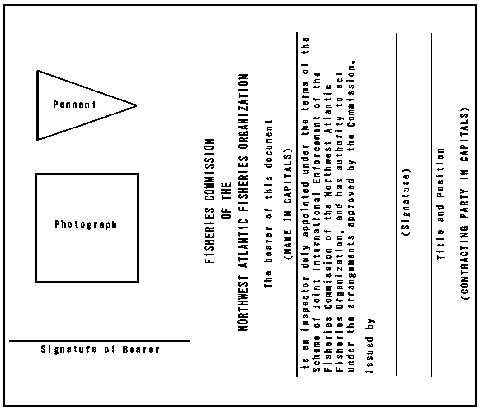
inspector means a person named by a contracting party set out in Schedule IV to carry out inspections in the Regulatory Area in accordance with the scheme of joint international enforcement established pursuant to Article XVIII of the Convention of Future Multilateral Cooperation in the Northwest Atlantic Fisheries that was ratified by Canada on November 30, 1978 and came into force on January 1, 1979, and who is in possession of an identification card issued by that contracting party in the form set out in Schedule V; (inspecteur)
- International Code of Signals
International Code of Signals means the International Code of Signals published by Transport Canada; (Code international de signaux)
- Signal L
Signal L means the signal prescribed in the International Code of Signals to mean You should stop your vessel instantly; (signal L)
- Signal SQ 1
Signal SQ 1 means the signal prescribed in the International Code of Signals to mean You should stop or heave to, otherwise I shall open fire on you; (signal SQ 1)
- Signal SQ 3
Signal SQ 3 means the signal prescribed in the International Code of Signals to mean You should stop, or heave to; I am going to board you. (signal SQ 3)
Flying of Pennants
42 (1) The flying of a fisheries patrol-boat pennant on a vessel identifies that vessel as a vessel with a fishery officer or fishery guardian on board.
(2) The flying of an inspection pennant on a vessel identifies that vessel as a vessel with an inspector on board.
Signalling
43 (1) Where a fishery officer or fishery guardian sends the Signal L, the Signal SQ 1 or the Signal SQ 3 to a vessel by any of the methods set out in subsection (2), the master of the vessel shall immediately comply with the direction of that signal.
(2) The following methods of signalling may be used to send signals to vessels:
(a) flag signalling using alphabetical flags;
(b) flashing light signalling using Morse symbols;
(c) sound signalling using Morse symbols;
(d) Morse signalling using hand-flags or arms;
(e) voice with or without using loud hailer;
(f) radiotelegraphy; and
(g) radiotelephony.
(3) Where any signal referred to in subsection (1) has been sent to a vessel, no person on board that vessel shall dump or throw anything overboard from that vessel until the fishery officer or fishery guardian who sent the signal indicates to the master of the vessel that the vessel may proceed.
Assisting Fishery Officer and Fishery Guardian
44 The master of a fishing vessel shall provide all reasonable assistance to a fishery officer or fishery guardian, including
(a) making the fishing gear used on or from the vessel available for inspection and for that purpose hauling in such gear and thawing the nets, where necessary;
(b) permitting the taking of photographs of the fisheries operations, including fishing gear and equipment; and
(c) where the fishery officer or fishery guardian is on board for more than four consecutive hours, providing food and accommodation equivalent to that provided to officers of the vessel.
Assisting Inspector
45 (1) Where an inspector sends the Signal L or the Signal SQ 3 by any of the methods set out in subsection 43(2) to a fishing vessel operating in the Regulatory Area, the master of the vessel shall immediately comply with the direction of that signal.
(2) The master of a fishing vessel operating in the Regulatory Area shall
(a) at the request of an inspector, permit the inspector to board the vessel; and
(b) provide the inspector with all reasonable assistance necessary to enable the inspector to carry out an inspection of the fishing operations, including
(i) making the fishing gear used on or from the vessel available for inspection and for that purpose hauling in such gear and thawing the nets, where necessary,
(ii) permitting the taking of photographs of the fisheries operations, including fishing gear and equipment, and
(iii) where the inspector is on board for more than four consecutive hours, providing food and accommodation equivalent to that provided to officers of the vessel.
(2.1) Where an inspector sends the Signal SQ 3 to a fishing vessel, no person on board that vessel shall retrieve any gear from the water for the period of 30 minutes after the signal is sent.
(3) Where, during an inspection in the Regulatory Area, an inspector finds any fishing gear or equipment the use or possession of which is contrary to the Act, the Atlantic Fishery Regulations, 1985 or these Regulations, the inspector may place a mark or seal on that fishing gear or equipment in a manner that will preserve the identity of the gear or equipment.
(4) No person other than a fishery officer shall remove a mark or seal placed on any fishing gear or equipment in accordance with subsection (3).
(5) Where a mark or seal has been placed on any fishing gear or equipment in accordance with subsection (3), no person shall
(a) alter or tamper with that mark or seal; or
(b) use, destroy or dispose of that fishing gear or equipment unless the mark or seal has been removed by a fishery officer.
- SOR/95-242, s. 4
Assisting Observers
Monitoring Fishing Activities
46 (1) This section does not apply in respect of a foreign fishing vessel.
(2) The owner or master of a fishing vessel shall, at the request of the Regional Director-General,
(a) permit an observer who is assigned the duties set out in paragraph 39(2)(a) to go on board that vessel to perform those duties and to remain on board for the period of time specified in the request; and
(b) arrange for the embarkation or disembarkation of the observer at such time and place as is specified in the request.
(3) The master of a fishing vessel shall provide all reasonable assistance to an observer who is assigned the duties set out in paragraph 39(2)(a), including
(a) providing a suitable work area, including a table and adequate lighting;
(b) providing, at the request of the observer, information relating to any matter mentioned in subsection 61(2) of the Act;
(c) providing, at the request of the observer, the position of the vessel in latitude and longitude;
(d) facilitating the sending and receiving of messages by means of the communications equipment on board the vessel;
(e) giving access to all areas of the vessel involved in fishing, processing and storage operations;
(f) permitting the taking of samples free of charge;
(g) providing suitable storage facilities for samples;
(h) assisting, at the request of the observer, in the examination and measurement of fishing gear on board the vessel;
(i) permitting the taking of photographs of the fisheries operations, including fishing gear and equipment;
(j) permitting the removal from the vessel of samples, records, photographs or film taken or made on board the vessel; and
(k) where the observer is on board for more than four consecutive hours, providing food and accommodation equivalent to that provided to officers of the vessel.
Monitoring Landing and Conducting Biological Examinations
- SOR/98-481, s. 5
47 The master of a fishing vessel that is landing fish at a fish landing station shall
(a) at the request of an observer who is assigned the duties set out in paragraph 39(2)(b), permit the observer to go on board the vessel to perform those duties; and
(b) provide the observer with such assistance as is reasonably necessary to enable the observer to perform those duties.
- SOR/98-481, s. 6
48 The owner or any person who has the care, charge or control of a fish landing station shall
(a) at the request of an observer who is assigned the duties set out in paragraph 39(2)(b) or (c), provide the observer with access to the fish landing station; and
(b) provide the observer with such assistance as is reasonably necessary to enable the observer to perform those duties, including
(i) making the fish at the fish landing station readily accessible to the observer,
(ii) providing the observer with a suitable work area, including a table and adequate lighting, and
(iii) permitting the observer to remove whole fish or portions of fish from the fish landing station free of charge.
- SOR/98-481, s. 8
Embarking and Disembarking Assistance
49 Where a fishery officer, fishery guardian, inspector or observer has to climb up or down more than 1.2 m to embark or disembark from a fishing vessel, sections 4 to 16 of the Pilot Ladder Regulations apply to the master of the fishing vessel, with such modifications as the circumstances may require.
PART VIIFishing for Experimental, Scientific, Educational, Aquatic Invasive Species Control or Public Display Purposes
Interpretation
50 In this Part, licence means a licence to fish for experimental, scientific, educational, aquatic invasive species control or public display purposes.
- SOR/2015-121, s. 35
Licence
51 No person shall fish for experimental, scientific, educational, aquatic invasive species control or public display purposes unless authorized to do so under a licence.
- SOR/2015-121, s. 35
52 Despite any provisions of any of the Regulations listed in subsection 3(4), the Minister may issue a licence if fishing for experimental, scientific, educational, aquatic invasive species control or public display purposes would be in keeping with the proper management and control of fisheries.
- SOR/2015-121, s. 35
Licence Fee
53 (1) The fee for a licence to fish for public display purposes is $100.
(2) There is no fee for a licence to fish for experimental, scientific, educational or aquatic invasive species control purposes.
- SOR/2015-121, s. 36
PART VIIIRelease of Live Fish into Fish Habitat and Transfer of Live Fish to a Fish Rearing Facility
Interpretation
54 In this Part, licence means a licence to release live fish into fish habitat or to transfer live fish to a fish rearing facility.
Release or Transfer of Fish
55 (1) Subject to subsection (2), no person shall, unless authorized to do so under a licence,
(a) release live fish into any fish habitat; or
(b) transfer any live fish to any fish rearing facility.
(2) Subsection (1) does not apply in respect of fish that is immediately returned to the waters in which it was caught.
Licence to Release or Transfer Fish
56 The Minister may issue a licence if
(a) the release or transfer of the fish would be in keeping with the proper management and control of fisheries;
(b) the fish do not have any disease or disease agent that may be harmful to the protection and conservation of fish; and
(c) the release or transfer of the fish will not have an adverse effect on the stock size of fish or the genetic characteristics of fish or fish stocks.
Licence Fee
57 There is no fee for a licence issued under this Part.
PART IXAuthorization to Alter Fish Habitat
Authorization
58 [Repealed, SOR/2013-191, s. 9]
PART XRemoval of Obstructions to the Passage of Fish
59 Where the Minister is satisfied that any natural obstruction that exists in any waters is interfering or is likely to interfere with the free passage of fish, the Minister may cause the obstruction to be removed in whole or in part.
PART XIPenalties and Forfeitures Proceeds
To Government of Canada
60 (1) Where an information is laid by a fishery officer or a fishery guardian employed by the Government of Canada relating to an offence under the Act, the payment of the proceeds of any penalty imposed arising from a conviction for the offence shall be made to the Minister.
(2) Where an information is laid by a fishery officer or a fishery guardian employed by the Government of Canada relating to an offence under the Act, the payment of any proceeds of the sale of any forfeited articles arising from a conviction for the offence shall be made to the Minister.
To Provincial Government
61 (1) Where an information is laid by a fishery officer or a fishery guardian employed by a provincial government relating to an offence under the Act and all of the expenses incurred in the prosecution of the offence are paid by the provincial government, the payment of the proceeds of any penalty imposed arising from a conviction for that offence shall be made to that provincial government.
(2) Where an information is laid by a fishery officer or a fishery guardian employed by a provincial government relating to an offence under the Act and all of the expenses incurred in the prosecution of the offence and in connection with the custody and disposal of any forfeited articles are paid by the provincial government, the payment of any proceeds of the sale of the forfeited articles arising from a conviction for that offence shall be made to that provincial government.
To Persons
62 (1) Where an information is laid by a person in circumstances other than those referred to in section 60 or 61 relating to an offence under the Act, the payment of the proceeds of any penalty imposed arising from a conviction for the offence shall be made
(a) one half to the person; and
(b) one half to the Minister or, where all of the expenses incurred in the prosecution of the offence are paid by a provincial government, to that provincial government.
(2) Where an information is laid by a person in circumstances other than those referred to in section 60 or 61 relating to an offence under the Act, the payment of any proceeds of the sale of any forfeited articles arising from a conviction for the offence shall be made, net of any expenses incurred in connection with the custody and sale of the forfeited articles,
(a) one half to the person; and
(b) one half to the Minister or, where all of the expenses incurred in the prosecution of the offence are paid by a provincial government, to that provincial government.
PART XIITicketable Offences
Prescribed Offences
63 The contravention of any provision of these Regulations set out in column I of an item of Schedule VIII is an offence to which section 79.7 of the Act applies and which may be described in tickets in the manner set out in column II of that item.
Fines
64 Where proceedings are commenced under section 79.7 of the Act, the amount of the fine for an offence described in column II of an item of Schedule VIII is the amount set out in column III of that item.
PART XIIIFishing in Waters Other than Canadian Fisheries Waters
Prohibitions
65 (1) Subject to subsection (2), no person on board a fishing vessel that is subject to the jurisdiction of Canada shall fish or trans-ship fish in waters other than Canadian fisheries waters except under the authority of a licence issued under section 68.
(2) Subsection (1) does not apply to a person on board a fishing vessel that is subject to the jurisdiction of Canada who is fishing
(a) in the Regulatory Area under the authority of a licence issued under the Atlantic Fishery Regulations, 1985; or
(b) in the Pacific Ocean for tuna under the authority of a licence issued under the Pacific Fishery Regulations, 1993.
- SOR/94-296, s. 2
66 (1) Subject to subsection (2), no person on board a fishing vessel that is subject to the jurisdiction of Canada shall, in waters that are subject to the jurisdiction of the United States, have any fishing gear on board the fishing vessel unless it is
(a) stored below deck; or
(b) otherwise removed from the place where it is normally used for fishing and placed where it is not readily available for fishing.
(2) Subsection (1) does not apply to a person who is fishing under the authority of a licence issued under section 68.
- SOR/94-296, s. 2
67 No person who is on board a fishing vessel that is subject to the jurisdiction of Canada shall, while the fishing vessel is in waters that are subject to the jurisdiction of the United States, resist or obstruct any enforcement officer of the United States while the officer is engaged in the enforcement of the fisheries laws of the United States.
- SOR/94-296, s. 2
68 (1) The Minister may issue a licence authorizing the use of a vessel that is subject to the jurisdiction of Canada in fishing or trans-shipping fish in waters other than Canadian fisheries waters if
(a) the fishing or trans-shipping of fish carried out under the authority of the licence would not contravene or undermine any international fisheries conservation scheme; and
(b) in the case where the fishing or trans-shipping of fish is to be carried out in waters that are subject to the jurisdiction of another state, the fishing or trans-shipping of fish by that vessel is authorized by a competent authority of that state.
(2) Subject to subsection (3), the fee for a licence referred to in subsection (1) is $500.
(3) There is no fee for a licence referred to in subsection (1) that is issued in respect of waters subject to the jurisdiction of Saint-Pierre-et-Miquelon.
- SOR/94-296, s. 2
PART XIVFish Stocks
69 For the purposes of section 6.3 of the Act, the major fish stocks referred to in sections 6.1 and 6.2 of the Act are listed in the table in Schedule IX.
70 (1) A plan to rebuild a major fish stock, required under subsection 6.2(1) of the Act, shall contain the following information:
(a) the stock status and stock trends;
(b) the probable causes for the stock’s decline;
(c) measurable objectives aimed at rebuilding the stock, including a target for rebuilding the stock;
(d) the timelines for achieving the objectives;
(e) the management measures aimed at achieving the objectives;
(f) a method to track progress towards achieving the objectives; and
(g) a schedule for a periodic review of the plan in order to assess progress towards achieving the objectives and to determine whether an adjustment to the plan is needed.
(2) The plan shall be developed within 24 months after the day on which the Minister first had knowledge that the major fish stock had declined to or below its limit reference point.
(3) The Minister may extend the time period to the extent necessary for completing the plan, by a period not exceeding 12 months.
(4) If the Minister extends the time period, the Minister shall publish the reasons for doing so on the Internet site of the Department.
(5) If fishing of the major fish stock while the plan is being developed is permitted by the Minister, the Minister shall ensure that the level of fishing of the stock during that time is consistent with the rebuilding of the stock above the limit reference point.
(6) Despite paragraph 1(d), if the Minister determines that it is not feasible to establish a timeline for achieving the target for rebuilding the major fish stock, the plan shall include, instead of such a timeline, the reasons why it is not feasible to do so.
(7) The Minister shall publish the plan to rebuild a major fish stock and the results of any periodic review of the plan on the Internet site of the Department.
SCHEDULE I(Paragraph 31(2)(b) and subsection 31(3))Topside Chafers
Regular Topside Chafer
1 A rectangular piece of netting that
a) is at least 1 ½ times the width of the area of the cod-end that is covered, where the width is measured at right angles to the long axis of the cod-end;
b) has a mesh size that is not less than the mesh size of the cod-end; and
c) is fastened to the cod-end only along the forward and lateral edges of the netting in a manner that will permit it to extend
(i) where a splitting strap is used, over not more of the cod-end than that part between the fourth mesh forward of the cod line mesh and the fourth mesh forward of the splitting strap, and
(ii) where a splitting strap is not used, over not more than one-third of the cod-end, measured from not less than the fourth mesh forward of the cod line mesh.
Modified Polish Topside Chafer
2 A rectangular piece of netting that
a) is made of twine of the same material and size as that of the cod-end, or of any single, thick, knotless twine material;
b) has a mesh size that is twice as large as the mesh size of the cod-end;
c) is attached to the rear portion of the topside of the cod-end; and
d) is fastened to the cod-end along the forward, lateral and rear edges of the netting in a manner that will cause each mesh to exactly overlie four meshes of the cod-end over which it extends.
Multiple Flap-Type Topside Chafer
3 A series of pieces of netting where
a) the aggregate length extends less than two-thirds of the length of the cod-end; and
b) each piece of netting
(i) is attached to the topside of the cod-end so that it overlaps the piece of netting immediately to its rear, if any,
(ii) has a mesh size that is not less than the mesh size of the cod-end,
(iii) is at least as wide as the cod-end, where the width is measured at right angles to the cod-end,
(iv) is not more than 10 meshes long, and
(v) is fastened by its forward edge only across the cod-end at right angles to its long axis.
SCHEDULE II / ANNEXE II(Section 41 / article 41)Fisheries Patrol-Boat Pennant / Fanion de patrouilleur des pêches
PART I / PARTIE I

PART II / PARTIE II

SCHEDULE III / ANNEXE III(Section 41 / article 41)
Inspection Pennant / Fanion d’inspection

SCHEDULE IV(Section 41)
| Item | Contracting Party |
|---|---|
| 1 | Bulgaria |
| 2 | Canada |
| 3 | Cuba |
| 4 | Denmark (in respect of the Faeroe Islands) |
| 5 | Estonia |
| 6 | European Economic Community |
| 7 | Iceland |
| 8 | Japan |
| 9 | Latvia |
| 10 | Lithuania |
| 11 | Norway |
| 12 | Poland |
| 13 | Portugal |
| 14 | Romania |
| 15 | Russia |
| 16 | Spain |
SCHEDULE V(Section 41)
Inspector’s Identification Card
SCHEDULE VI
SCHEDULE VII
SCHEDULE VIII(Sections 63 and 64)
Prescribed Offences and Fines
| Item | Column I | Column II | Column III |
|---|---|---|---|
| Provision of Regulations | Description of Offence | Amount of Fine | |
| 1 | 11 | Failing to produce licence, fisher’s registration card or provincial or territorial fisher’s certificate | $35 |
| 2 | 15(1)(c) | Use or produce a document issued to another under pretence of being the holder | 75 |
| 3 | 15(3) | Permit another person to use licence | 75 |
| 4 | 27(1)(b) | Set fishing gear not identified by owner’s name | 35 |
| 5 | 27(1)(b) | Operate fishing gear not identified by owner’s name | 35 |
| 6 | 27(1)(b) | Leave unattended fishing gear not identified by owner’s name | 35 |
| 7 | 33 | Fail to forthwith return fish to water | 50 |
| 8 | 33 | Fail to release fish in least harmful manner | 50 |
| 9 | 36(1)(a) | Possess fish the species of which cannot be readily determined | 50 |
| 10 | 36(1)(b) | Possess fish the number of which cannot be readily determined | 50 |
| 11 | 36(1)(c) | Possess fish the weight of which cannot be readily determined | 50 |
| 12 | 36(1)(d) | Possess fish the size of which cannot be readily determined | 50 |
- SOR/94-47, s. 1
- SOR/2020-255, s. 9
SCHEDULE IX(Section 69)Major Fish Stocks
Marginal note:Definition of NAFO
1 In this Schedule, NAFO means the Northwest Atlantic Fisheries Organization.
TABLE
Column I Column II Column III Item (French) Stock Name Scientific Name of Species Stock Area 1 (74) Acadian redfish, Units 1 and 2 Sebastes fasciatus The Area composed of (a) Division 3P described in paragraph 4(b) of Note A of Schedule III to the Atlantic Fishery Regulations, 1985;
(b) Divisions 4R, 4S, 4T and 4V described in paragraph 5(b) of that note; and
(c) the portion of Division 4W described in paragraph 5(b) of that note enclosed by straight lines joining the following points in the order in which they are listed: 44°10′ north latitude and 60°00′ west longitude, 44°10′ north latitude and 61°00′ west longitude, 43°30′ north latitude and 61°00′ west longitude, 43°30′ north latitude and 61°30′ west longitude, 43°40′ north latitude and 61°30′ west longitude, 43°40′ north latitude and 61°40′ west longitude, 43°50′ north latitude and 61°40′ west longitude, 43°50′ north latitude and 62°10′ west longitude, 42°40′ north latitude and 62°10′ west longitude, 42°40′ north latitude and 60°40′ west longitude, 43°00′ north latitude and 60°40′ west longitude, 43°00′ north latitude and 59°00′ west longitude, 44°10′ north latitude and 59°00′ west longitude and 44°10′ north latitude and 60°00′ west longitude
2 (75) Acadian redfish, Unit 3 Sebastes fasciatus The Area composed of (a) the portion of Division 4W described in paragraph 5(b) of Note A of Schedule III to the Atlantic Fishery Regulations, 1985 lying north of the straight lines joining the following points in the order in which they are listed: 44°10′ north latitude and 60°00′ west longitude, 44°10′ north latitude and 61°00′ west longitude, 43°30′ north latitude and 61°00′ west longitude, 43°30′ north latitude and 61°30′ west longitude, 43°40′ north latitude and 61°30′ west longitude, 43°40′ north latitude and 61°40′ west longitude, 43°50′ north latitude and 61°40′ west longitude, 43°50′ north latitude and 62°10′ west longitude, 42°40′ north latitude and 62°10′ west longitude and 42°40′ north latitude and 63°20′ west longitude;
(b) Division 4X described in paragraph 5(b) of that note; and
(c) the portion of Subarea 5 described in paragraph 6(a) of that note lying west of 67°40′ west longitude
3 (60) American plaice, NAFO 4T Hippoglossoides platessoides Division 4T described in paragraph 5(b) of Note A of Schedule III to the Atlantic Fishery Regulations, 1985 4 (52) Arctic char, Cambridge Bay (Halokvik River) Salvelinus alpinus The Area composed of (a) the Halokvik River (30 Mile River); and
(b) all bodies of fresh water that flow directly or indirectly into the Halokvik River (30 Mile River)
5 (53) Arctic char, Cambridge Bay (Jayko River) Salvelinus alpinus The Area composed of (a) the Jayko River; and
(b) all bodies of fresh water that flow directly or indirectly into the Jayko River
6 (56) Arctic char, Cumberland Sound (Ijaruvung Lake) Salvelinus alpinus The Area composed of (a) the Millurialiup River, which flows into Millut Bay at 66°37′42″ north latitude and 67°34′39″ west longitude; and
(b) all bodies of fresh water that flow directly or indirectly into the Millurialiup River
7 (55) Arctic char, Cumberland Sound (Iqalugaarjuit Fjord) Salvelinus alpinus The Area composed of all bodies of fresh water that flow directly or indirectly into the Iqalugaarjuit Fjord located at 65°40′ north latitude and 65°05′ west longitude 8 (54) Arctic char, Cumberland Sound (Irvine Inlet) Salvelinus alpinus The Area composed of (a) the McKeand River; and
(b) all bodies of fresh water that flow directly or indirectly into the McKeand River
9 (40) Arctic surfclam, Banquereau Mactromeris polynyma The Area composed of the portions of Subdivision 4Vs and of Division 4W described in paragraph 5(b) of Note A of Schedule III to the Atlantic Fishery Regulations, 1985 enclosed by rhumb lines joining the following points in the order in which they are listed: 45°13′26″ north latitude and 57°29′17″ west longitude, 45°02′37″ north latitude and 57°52′36″ west longitude, 44°47′53″ north latitude and 58°53′23″ west longitude, 44°48′11″ north latitude and 60°01′53″ west longitude, 44°23′09″ north latitude and 60°01′12″ west longitude, 44°26′55″ north latitude and 59°09′56″ west longitude, 43°52′42″ north latitude and 58°53′57″ west longitude, 44°03′43″ north latitude and 58°15′30″ west longitude, 44°25′04″ north latitude and 57°06′21″ west longitude and 45°13′26″ north latitude and 57°29′17″ west longitude 10 (41) Arctic surfclam, Grand Bank Mactromeris polynyma The Area composed of Divisions 3L, 3N and 3O described in paragraph 4(b) of Note A of Schedule III to the Atlantic Fishery Regulations, 1985 11 (47) Atlantic cod, NAFO 2J3KL Gadus morhua The Area composed of Division 2J described in paragraph 3(b) of Note A of Schedule III to the Atlantic Fishery Regulations, 1985 and Divisions 3K and 3L described in paragraph 4(b) of that note 12 (48) Atlantic cod, NAFO 3Pn4RS Gadus morhua The Area composed of Subdivision 3Pn described in paragraph 4(b) of Note A of Schedule III to the Atlantic Fishery Regulations, 1985 and Divisions 4R and 4S described in paragraph 5(b) of that note 13 (49) Atlantic cod, NAFO 3Ps Gadus morhua Subdivision 3Ps described in paragraph 4(b) of Note A of Schedule III to the Atlantic Fishery Regulations, 1985 14 (50) Atlantic cod, NAFO 4TVn Gadus morhua The Area composed of Division 4T described in paragraph 5(b) of Note A of Schedule III to the Atlantic Fishery Regulations, 1985 and Subdivision 4Vn described in that paragraph 15 (51) Atlantic cod, NAFO 4X5Y Gadus morhua The Area composed of Division 4X described in paragraph 5(b) of Note A of Schedule III to the Atlantic Fishery Regulations, 1985 and Division 5Y described in paragraph 6(b) of that note 16 (14) Atlantic halibut, NAFO 3NOPs4VWX5Z Hippoglossus hippoglossus The Area composed of Divisions 3N and 3O and Subdivision 3Ps described in paragraph 4(b) of Note A of Schedule III to the Atlantic Fishery Regulations, 1985, Divisions 4V, 4W and 4X described in paragraph 5(b) of that note and Division 5Z described in paragraph 6(b) of that note 17 (15) Atlantic halibut, NAFO 4RST Hippoglossus hippoglossus The Area composed of Divisions 4R, 4S and 4T described in paragraph 5(b) of Note A of Schedule III to the Atlantic Fishery Regulations, 1985 18 (20) Atlantic herring, NAFO 4T (Fall Spawner Component) Clupea harengus Division 4T described in paragraph 5(b) of Note A of Schedule III to the Atlantic Fishery Regulations, 1985 19 (19) Atlantic herring, NAFO 4T (Spring Spawner Component) Clupea harengus Division 4T described in paragraph 5(b) of Note A of Schedule III to the Atlantic Fishery Regulations, 1985 20 (42) Atlantic mackerel Scomber scombrus The Area composed of Subarea 3 described in paragraph 4(a) of Note A of Schedule III to the Atlantic Fishery Regulations, 1985 and Subarea 4 described in paragraph 5(a) of that note 21 (79) Bocaccio rockfish Sebastes paucispinis The Area composed of all Areas as defined in section 1 of the Pacific Fishery Management Area Regulations, 2007 22 (80) Canary rockfish Sebastes pinniger The Area composed of all Areas as defined in section 1 of the Pacific Fishery Management Area Regulations, 2007 23 (2) Capelin, NAFO 2J3KL Mallotus villosus The Area composed of Division 2J described in paragraph 3(b) of Note A of Schedule III to the Atlantic Fishery Regulations, 1985 and Divisions 3K and 3L described in paragraph 4(b) of that note 24 (68) Chinook salmon, Okanagan Oncorhynchus tshawytscha The Area composed of (a) the part of Osoyoos Lake situated in Canada;
(b) the part of the Okanagan River situated in Canada;
(c) the part of the Similkameen River situated in Canada; and
(d) all bodies of fresh water situated in Canada that flow directly or indirectly into Osoyoos Lake, the Okanagan River or the Similkameen River
25 (67) Chinook salmon, West Coast of Vancouver Island Oncorhynchus tshawytscha The Area composed of (a) all rivers that drain into the Pacific Ocean on the west coast of Vancouver Island between the Goodspeed River in the north and the Sooke River in the south;
(b) the Goodspeed River and the Sooke River; and
(c) all bodies of fresh water that flow directly or indirectly into any of the rivers referred to in paragraph (a) or (b)
26 (69) Chinook salmon, Yukon Oncorhynchus tshawytscha The Area composed of (a) the part of the Yukon River situated in Canada;
(b) the part of the Porcupine River situated in Canada; and
(c) all bodies of fresh water situated in Canada that flow directly or indirectly into the Yukon River or the Porcupine River
27 (66) Coho salmon, Interior Fraser Oncorhynchus kisutch The Area composed of (a) the part of the Fraser River that is upstream from Hells Gate; and
(b) all bodies of fresh water that flow directly or indirectly into the part of the Fraser River referred to in paragraph (a)
28 (76) Deepwater redfish, Units 1 and 2 Sebastes mentella The Area composed of (a) Division 3P described in paragraph 4(b) of Note A of Schedule III to the Atlantic Fishery Regulations, 1985;
(b) Divisions 4R, 4S, 4T and 4V described in paragraph 5(b) of that note; and
(c) the portion of Division 4W described in paragraph 5(b) of that note enclosed by straight lines joining the following points in the order in which they are listed: 44°10′ north latitude and 60°00′ west longitude, 44°10′ north latitude and 61°00′ west longitude, 43°30′ north latitude and 61°00′ west longitude, 43°30′ north latitude and 61°30′ west longitude, 43°40′ north latitude and 61°30′ west longitude, 43°40′ north latitude and 61°40′ west longitude, 43°50′ north latitude and 61°40′ west longitude, 43°50′ north latitude and 62°10′ west longitude, 42°40′ north latitude and 62°10′ west longitude, 42°40′ north latitude and 60°40′ west longitude, 43°00′ north latitude and 60°40′ west longitude, 43°00′ north latitude and 59°00′ west longitude, 44°10′ north latitude and 59°00′ west longitude and 44°10′ north latitude and 60°00′ west longitude
29 (59) Geoduck Panopea abrupta The Area composed of all Areas as defined in section 1 of the Pacific Fishery Management Area Regulations, 2007 30 (26) Giant red sea cucumber Apostichopus californicus The Area composed of all Areas as defined in section 1 of the Pacific Fishery Management Area Regulations, 2007 31 (58) Green sea urchin Strongylocentrotus droebachiensis The Area composed of all Areas as defined in section 1 of the Pacific Fishery Management Area Regulations, 2007 32 (16) Greenland halibut, NAFO 4RST Reinhardtius hippoglossoides The Area composed of Divisions 4R, 4S and 4T described in paragraph 5(b) of Note A of Schedule III to the Atlantic Fishery Regulations, 1985 33 (1) Haddock, NAFO 4X5Y Melanogrammus aeglefinus The Area composed of Division 4X described in paragraph 5(b) of Note A of Schedule III to the Atlantic Fishery Regulations, 1985 and Division 5Y described in paragraph 6(b) of that note 34 (63) Iceland scallop, Scallop Fishing Area 16E Chlamys islandica The portion of Scallop Fishing Area 16 illustrated and enumerated in Part III of Schedule XV to the Atlantic Fishery Regulations, 1985 bounded by the coast and enclosed by straight lines joining the following points in the order in which they are listed: 50°16′ north latitude and 64°12′ west longitude, 50°04′30″ north latitude and 64°12′ west longitude, 50°00′ north latitude and 63°26′30″ west longitude and 50°12′30″ north latitude and 63°26′30″ west longitude 35 (64) Iceland scallop, Scallop Fishing Area 16F Chlamys islandica The portion of Scallop Fishing Area 16 illustrated and enumerated in Part III of Schedule XV to the Atlantic Fishery Regulations, 1985, bounded by the coast and enclosed by straight lines joining the following points in the order in which they are listed: 50°12′30″ north latitude and 63°26′30″ west longitude, 50°00′ north latitude and 63°26′30″ west longitude, 49°57′ north latitude and 62°54′ west longitude, and 50°17′ north latitude and 62°54′ west longitude 36 (27) Lobster, Lobster Fishing Areas 19 to 21 Homarus americanus The Area composed of Lobster Fishing Areas 19, 20A, 20B and 21 illustrated and enumerated in Part III of Schedule XIII to the Atlantic Fishery Regulations, 1985 37 (28) Lobster, Lobster Fishing Area 22 Homarus americanus Lobster Fishing Area 22 illustrated and enumerated in Part III of Schedule XIII to the Atlantic Fishery Regulations, 1985 38 (29) Lobster, Lobster Fishing Areas 23 to 26 Homarus americanus The Area composed of Lobster Fishing Areas 23, 24, 25, 26A and 26B illustrated and enumerated in Part III of Schedule XIII to the Atlantic Fishery Regulations, 1985 39 (30) Lobster, Lobster Fishing Area 27 Homarus americanus Lobster Fishing Area 27 illustrated and enumerated in Part IV of Schedule XIII to the Atlantic Fishery Regulations, 1985 40 (31) Lobster, Lobster Fishing Area 29 Homarus americanus Lobster Fishing Area 29 illustrated and enumerated in Part V of Schedule XIII to the Atlantic Fishery Regulations, 1985 41 (32) Lobster, Lobster Fishing Area 30 Homarus americanus Lobster Fishing Area 30 illustrated and enumerated in Part V of Schedule XIII to the Atlantic Fishery Regulations, 1985 42 (33) Lobster, Lobster Fishing Area 31A Homarus americanus Lobster Fishing Area 31A illustrated and enumerated in Part V of Schedule XIII to the Atlantic Fishery Regulations, 1985 43 (34) Lobster, Lobster Fishing Area 31B Homarus americanus Lobster Fishing Area 31B illustrated and enumerated in Part V of Schedule XIII to the Atlantic Fishery Regulations, 1985 44 (35) Lobster, Lobster Fishing Area 32 Homarus americanus Lobster Fishing Area 32 illustrated and enumerated in Part V of Schedule XIII to the Atlantic Fishery Regulations, 1985 45 (36) Lobster, Lobster Fishing Area 33 Homarus americanus Lobster Fishing Area 33 illustrated and enumerated in Part V of Schedule XIII to the Atlantic Fishery Regulations, 1985 46 (37) Lobster, Lobster Fishing Area 34 Homarus americanus Lobster Fishing Area 34 illustrated and enumerated in Part V of Schedule XIII to the Atlantic Fishery Regulations, 1985 47 (38) Lobster, Lobster Fishing Area 41 Homarus americanus Lobster Fishing Area 41 illustrated and enumerated in Part II of Schedule XIII to the Atlantic Fishery Regulations, 1985 48 (8) Northern shrimp, Shrimp Fishing Area 8 Pandalus borealis Shrimp Fishing Area 8 illustrated and enumerated in Schedule XVII to the Atlantic Fishery Regulations, 1985 49 (9) Northern shrimp, Shrimp Fishing Area 9 Pandalus borealis Shrimp Fishing Area 9 illustrated and enumerated in Schedule XVII to the Atlantic Fishery Regulations, 1985 50 (10) Northern shrimp, Shrimp Fishing Area 10 Pandalus borealis Shrimp Fishing Area 10 illustrated and enumerated in Schedule XVII to the Atlantic Fishery Regulations, 1985 51 (11) Northern shrimp, Shrimp Fishing Area 12 Pandalus borealis Shrimp Fishing Area 12 illustrated and enumerated in Schedule XVII to the Atlantic Fishery Regulations, 1985 52 (12) Northern shrimp, Shrimp Fishing Areas 13 to 15 Pandalus borealis The Area composed of Shrimp Fishing Areas 13 to 15 illustrated and enumerated in Schedule XVII to the Atlantic Fishery Regulations, 1985 53 (44) Pacific hake, Offshore Merluccius productus The Area composed of Areas 1 to 12, 20, 21, 23 to 27, 101 to 111, 121, 123 to 127, 130 and 142 described in Schedule 2 to the Pacific Fishery Management Area Regulations, 2007 54 (17) Pacific halibut Hippoglossus stenolepis The Area composed of all Areas as defined in section 1 of the Pacific Fishery Management Area Regulations, 2007 55 (21) Pacific herring, Central Coast Clupea pallasii The Area composed of (a) the portion of Subarea 6-13 described in Schedule 2 to the Pacific Fishery Management Area Regulations, 2007 lying south of the straight line joining the points at 52°36′19″ north latitude and 129°13′16″ west longitude and 52°36′24″ north latitude and 129°10′38″ west longitude;
(b) the portion of Subareas 6-16 and 6-19 described in that Schedule lying south of the straight lines joining the following points in the order in which they are listed: 52°36′47″ north latitude and 128°55′52″ west longitude, 52°38′51″ north latitude and 128°53′21″ west longitude and 52°38′55″ north latitude and 128°53′23″ west longitude; and
(c) Subareas 6-17, 6-18 and 6-25, Area 7 and Subareas 8-2 to 8-6 and 8-16 described in that Schedule
56 (25) Pacific herring, Haida Gwaii Clupea pallasii The Area composed of Subareas 2-1 to 2-19 and 2-31 to 2-37 described in Schedule 2 to the Pacific Fishery Management Area Regulations, 2007 57 (24) Pacific herring, Prince Rupert District Clupea pallasii The Area composed of Areas 3 to 5 described in Schedule 2 to the Pacific Fishery Management Area Regulations, 2007 58 (23) Pacific herring, Strait of Georgia Clupea pallasii The Area composed of (a) Subareas 13-1 to 13-11 and 13-13 to 13-15 described in Schedule 2 to the Pacific Fishery Management Area Regulations, 2007;
(b) Areas 14 to 19 and 28 described in that Schedule;
(c) Subareas 29-1 to 29-7 and 29-9 to 29-14 described in that Schedule;
(d) the portion of Subarea 29-15 described in that Schedule lying west of the straight lines joining the following points in the order in which they are listed: 49°10′15″ north latitude and 122°40′03″ west longitude, 49°14′57″ north latitude and 122°39′50″ west longitude and 49°20′23″ north latitude and 122°40′50″ west longitude; and
(e) Subarea 29-17 described in that Schedule
59 (22) Pacific herring, West Coast of Vancouver Island Clupea pallasii The Area composed of Areas 23 to 25 described in Schedule 2 to the Pacific Fishery Management Area Regulations, 2007 60 (85) Pacific ocean perch, North and West Coasts of Haida Gwaii Sebastes alutus The Area composed of (a) Area 1 described in Schedule 2 to the Pacific Fishery Management Area Regulations, 2007;
(b) the portion of Subarea 2-38 described in that Schedule lying north of the straight line joining the points at 52°20′ north latitude and 132°00′ west longitude and 52°20′ north latitude and 131°30′ west longitude;
(c) Subareas 2-39 to 2-100 described in that Schedule;
(d) Areas 3 to 5 and 101, Subarea 102-1, Areas 103 and 104 and Subarea 105-1 described in that Schedule;
(e) the portion of Subarea 130-3 described in that Schedule lying north of 51°56′ north latitude and west of the straight line joining the points at 52°20′ north latitude and 132°00′ west longitude and 51°56′ north latitude and 131°31′04″ west longitude;
(f) the portion of Subarea 142-1 described in that Schedule lying north of the straight line joining the points at 52°20′ north latitude and 132°00′ west longitude and 52°20′ north latitude and 131°30′ west longitude and west of the straight line joining the points at 52°20′ north latitude and 132°00′ west longitude and 51°56′ north latitude and 131°31′04″ west longitude; and
(g) Subarea 142-2 described in that Schedule
61 (84) Pacific ocean perch, Queen Charlotte Sound Sebastes alutus The Area composed of (a) Subareas 2-1 to 2-19 and 2-31 to 2-37 described in Schedule 2 to the Pacific Fishery Management Area Regulations, 2007;
(b) the portion of Subarea 2-38 described in that Schedule lying south of the straight line joining the points at 52°20′ north latitude and 132°00′ west longitude and 52°20′ north latitude and 131°30′ west longitude;
(c) Areas 6 to 11, Subarea 12-14, Area 27, Subareas 102-2, 102-3 and 105-2, Areas 106 to 111 and Subareas 127-1, 127-3, 127-4, 130-1 and 130-2 described in that Schedule;
(d) the portions of Subareas 26-11, 126-4 and 127-2 described in that Schedule lying north of 50°06′ north latitude;
(e) the portion of Subarea 130-3 described in that Schedule lying south of 51°56′ north latitude and east of the straight line joining the points at 52°20′ north latitude and 132°00′ west longitude and 51°56′ north latitude and 131°31′04″ west longitude; and
(f) the portion of Subarea 142-1 described in that Schedule lying south of the straight line joining the points at 52°20′ north latitude and 132°00′ west longitude and 52°20′ north latitude and 131°30′ west longitude and east of the straight line joining the points at 52°20′ north latitude and 132°00′ west longitude and 51°56′ north latitude and 131°31′04″ west longitude
62 (86) Pacific ocean perch, West Coast of Vancouver Island Sebastes alutus The Area composed of (a) Areas 21 and 23 to 25, Subareas 26-1 to 26-10, Areas 121 and 123 to 125 and Subareas 126-1 to 126-3 described in Schedule 2 to the Pacific Fishery Management Area Regulations, 2007; and
(b) the portions of Subareas 26-11, 126-4 and 127-2 described in that Schedule lying south of 50°06′ north latitude
63 (70) Pink salmon, Fraser Oncorhynchus gorbuscha The Area composed of (a) the Quesnel River;
(b) the part of the Fraser River that is downstream of its confluence with the Quesnel River; and
(c) all bodies of fresh water that flow directly or indirectly into the water bodies described in paragraph (a) or (b)
64 (18) Pollock, NAFO 4X5 (Western Component) Pollachius virens The Area composed of (a) the portion of Division 4X described in paragraph 5(b) of Note A of Schedule III to the Atlantic Fishery Regulations, 1985 lying west of the straight lines joining the following points in the order in which they are listed: 44°09′ north latitude and 64°29′ west longitude, 44°00′ north latitude and 64°20′ west longitude, 43°20′ north latitude and 64°20′ west longitude, 43°20′ north latitude and 64°30′ west longitude, 43°10′ north latitude and 64°30′ west longitude, 43°10′ north latitude and 64°50′ west longitude, 42°50′ north latitude and 64°50′ west longitude, 42°50′ north latitude and 65°30′ west longitude, and 42°00′ north latitude and 65°30′ west longitude; and
(b) Subarea 5 described in paragraph 6(a) of that note
65 (83) Quillback rockfish, Inside Waters Sebastes maliger The Area composed of Subareas 12-1 to 12-13 and 12-15 to 12-48 and Areas 13 to 20, 28 and 29 described in Schedule 2 to the Pacific Fishery Management Area Regulations, 2007 66 (82) Quillback rockfish, Outside Waters Sebastes maliger The Area composed of Areas 1 to 11, Subarea 12-14 and Areas 21, 23 to 27, 101 to 111, 121, 123 to 127, 130 and 142 described in Schedule 2 to the Pacific Fishery Management Area Regulations, 2007 67 (57) Red sea urchin Strongylocentrotus franciscanus The Area composed of all Areas as defined in section 1 of the Pacific Fishery Management Area Regulations, 2007 68 (46) Sablefish Anoplopoma fimbria The Area composed of all Areas as defined in section 1 of the Pacific Fishery Management Area Regulations, 2007 69 (65) Sea scallop, Scallop Fishing Area 20 Placopecten magellanicus Scallop Fishing Area 20 illustrated and enumerated in Part III of Schedule XV to the Atlantic Fishery Regulations, 1985 70 (43) Silver hake, NAFO 4VWX Merluccius bilinearis The Area composed of Divisions 4V, 4W and 4X described in paragraph 5(b) of Note A of Schedule III to the Atlantic Fishery Regulations, 1985 71 (6) Snow crab, Crab Fishing Area 12A Chionoecetes opilio The portion of Crab Fishing Area 12 illustrated and enumerated in Part IIB of Schedule XI to the Atlantic Fishery Regulations, 1985 bounded by the coast and enclosed by straight lines joining the following points in the order in which they are listed: 49°13′15″ north latitude and 65°53′30″ west longitude, 49°21′25″ north latitude and 65°35′30″ west longitude, 49°17′ north latitude and 64°44′ west longitude, 48°53′30″ north latitude and 63°48′54″ west longitude and 48°45′18″ north latitude and 64°09′54″ west longitude 72 (7) Snow crab, Crab Fishing Area 12B Chionoecetes opilio The portion of Crab Fishing Area 12 illustrated and enumerated in Part IIB of Schedule XI to the Atlantic Fishery Regulations, 1985 bounded by the coast and enclosed by straight lines joining the following points in the order in which they are listed: 49°51′50″ north latitude and 64°31′26″ west longitude, 49°40′20″ north latitude and 64°54′50″ west longitude, 49°00′ north latitude and 63°00′ west longitude, 48°30′ north latitude and 60°00′ west longitude, 49°05′ north latitude and 60°00′ west longitude and 49°05′ north latitude and 61°42′ west longitude 73 (3) Snow crab, North-Eastern Nova Scotia (N-ENS) Chionoecetes opilio The Area composed of Crab Fishing Areas 20 to 22 illustrated and enumerated in Part III of Schedule XI to the Atlantic Fishery Regulations, 1985 74 (5) Snow crab, South-Eastern Nova Scotia (S-ENS) Chionoecetes opilio The Area composed of the portion of Crab Fishing Areas 23 and 24 illustrated and enumerated in Part IIB of Schedule XI to the Atlantic Fishery Regulations, 1985 lying east of Divisions 4W and 4X described in paragraph 5(b) of Note A of Schedule III to those Regulations 75 (4) Snow crab, Southern Gulf of St. Lawrence Chionoecetes opilio The Area known as the Southern Gulf of St. Lawrence that is composed of (a) the portion of Crab Fishing Area 12 illustrated and enumerated in Part IIB of Schedule XI to the Atlantic Fishery Regulations, 1985 lying south and west of the straight lines joining the following points in the order in which they are listed: 48°45′18″ north latitude and 64°09′54″ west longitude, 48°53′30″ north latitude and 63°48′54″ west longitude, 49°17′ north latitude and 64°44′ west longitude, 49°21′25″ north latitude and 65°35′30″ west longitude, 49°40′20″ north latitude and 64°54′50″ west longitude, 49°00′ north latitude and 63°08′30″ west longitude, 48°02′30″ north latitude and 61°07′ west longitude, 47°44′30″ north latitude and 60°25′15″ west longitude, 47°21′30″ north latitude and 60°16′ west longitude, 47°18′30″ north latitude and 60°18′ west longitude, 47°16′25″ north latitude and 60°17′40″ west longitude and 47°02′15″ north latitude and 60°24′55″ west longitude; and
(b) Crab Fishing Areas 18, 19, 25 and 26 illustrated and enumerated in Part III of that Schedule
76 (71) Sockeye salmon, Fraser (Early Stuart) Oncorhynchus nerka The Area composed of (a) Takla Lake;
(b) Trembleur Lake;
(c) all bodies of fresh water that flow directly or indirectly into Takla Lake;
(d) all bodies of fresh water, except the Middle River, that flow directly or indirectly into Trembleur Lake; and
(e) all bodies of fresh water that flow directly or indirectly into the Middle River
77 (72) Sockeye salmon, Somass (Barkley Sound) Oncorhynchus nerka The Area composed of (a) Great Central Lake;
(b) Sproat Lake;
(c) the Stamp River and the Sproat River;
(d) Hucuktlis Lake (formerly Henderson Lake); and
(e) all bodies of fresh water that flow directly or indirectly into any of the water bodies referred to in paragraphs (a) to (d)
78 (73) Sockeye salmon, Stikine Oncorhynchus nerka The Area composed of (a) the part of the Stikine River situated in Canada; and
(b) all bodies of fresh water situated in Canada that flow directly or indirectly into the Stikine River
79 (13) Spot prawn Pandalus platyceros The Area composed of all Areas as defined in section 1 of the Pacific Fishery Management Area Regulations, 2007 80 (45) White hake, NAFO 4T Urophycis tenuis Division 4T described in paragraph 5(b) of Note A of Schedule III to the Atlantic Fishery Regulations, 1985 81 (62) Winter flounder, NAFO 4T Pseudopleuronectes americanus Division 4T described in paragraph 5(b) of Note A of Schedule III to the Atlantic Fishery Regulations, 1985 82 (61) Witch flounder, NAFO 4RST Glyptocephalus cynoglossus The Area composed of Divisions 4R, 4S and 4T described in paragraph 5(b) of Note A of Schedule III to the Atlantic Fishery Regulations, 1985 83 (78) Yelloweye rockfish, Inside Waters Sebastes ruberrimus The Area composed of Subareas 12-1 to 12-13 and 12-15 to 12-48 and Areas 13 to 20, 28 and 29 described in Schedule 2 to the Pacific Fishery Management Area Regulations, 2007 84 (77) Yelloweye rockfish, Outside Waters Sebastes ruberrimus The Area composed of Areas 1 to 11, Subarea 12-14 and Areas 21, 23 to 27, 101 to 111, 121, 123 to 127, 130 and 142 described in Schedule 2 to the Pacific Fishery Management Area Regulations, 2007 85 (81) Yellowmouth rockfish Sebastes reedi The Area composed of all Areas as defined in section 1 of the Pacific Fishery Management Area Regulations, 2007 86 (39) Yellowtail flounder, NAFO 4T Limanda ferruginea Division 4T described in paragraph 5(b) of Note A of Schedule III to the Atlantic Fishery Regulations, 1985
Page Details
- Date modified: